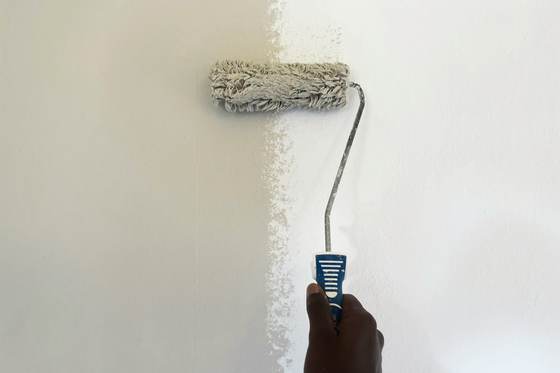
How the figures are worked out
Wall area. 2 × (length + width) × height. That treats the room as a box, which is close enough for almost every room, and generous where it is wrong (alcoves, chimney breasts) in a direction that helps you.
Ceiling. Length × width, added only if you tick the box.
Openings. Each door is taken as 1.9 m² and each window as 1.5 m², which are typical sizes. If yours are far off, count the real area and enter it as however many "doors" gets you close.
Total to cover. Net area × number of topcoats. Primer is worked out separately, at one pass over the net area for each primer coat, because you almost never want the same number of primer and finish coats.
Litres. Total area divided by the coverage figure. Tins are that divided by the tin size, rounded up.
In imperial mode the coverage figure is square feet per US gallon, and it is converted properly rather than relabelled: 400 sq ft/gal is about 9.8 m²/L, not 400 m²/L.
The part a calculator cannot do
Paint quantity is simple arithmetic. Paint success is almost entirely about what is under it, and that is where renovations go wrong.
Preparation is most of the job. Filling, sanding, caulking the gap between skirting and wall, sanding again, dusting off, masking. On a room that has been lived in, expect to spend more time preparing than painting. Paint does not hide a defect; it lights it from the side and points at it.
New plaster needs to dry, then needs a mist coat. Fresh plaster holds water for weeks — longer in winter, longer still with no heating or ventilation. Sealing it too early traps moisture and the paint peels in sheets months later. The mist coat is emulsion thinned with water, and its job is to soak in and give the finish coat something to grip.
Sheen decides how much you see. A flat matt finish hides an uneven wall and marks easily. An eggshell or satin wipes clean and shows every ripple. In a hallway with children, the washable finish is worth the honesty about your walls; in a bedroom, matt is kinder to old plaster.
Light changes the colour, twice. A sample patch in north light and the same patch under a warm bulb at night are two different colours. Paint a decent-sized patch — A3 at minimum, ideally a metre square — and look at it in the morning and the evening before you order twenty litres.
Order of work
Ceiling first, then walls, then woodwork. The logic is gravity and overspray: anything that drips or splatters lands on something you have not finished yet. Woodwork last because it is the most exacting and the easiest to catch with a roller.
Within a renovation, decorating comes late but not last. It sits after carpentry and tiling, and before flooring, so that the mess falls on a floor you are about to cover and so the final touch-ups can happen after everything else has been knocked about.
Common questions
- Why does my paint not cover as much as the tin says?
- Because the coverage figure on a tin is measured on a smooth, sealed, previously painted surface in ideal conditions. Bare plaster, filler, textured surfaces and any colour change all drink more. Treat the tin figure as a ceiling, not an average.
- How many coats do I actually need?
- Two is the normal answer and the one to budget for. Three when you are going light over dark, when the colour is strong and saturated, or on bare plaster even after a mist coat. One coat only works when you are refreshing the identical colour on a sound surface.
- Do I need primer?
- New plaster needs a mist coat — emulsion thinned with water — before anything else, or the finish coat will not bond. Bare wood, metal, patched filler and any big colour change all benefit from a primer. Painting over sound, previously painted walls in a similar colour usually does not need it.
- Should I buy all the paint at once?
- Yes, in one batch, from one order. Factory tinting varies slightly between batches, and the difference is visible on a long wall. If you are mixing tins, box them — pour all of them into one large container and stir — before you start.