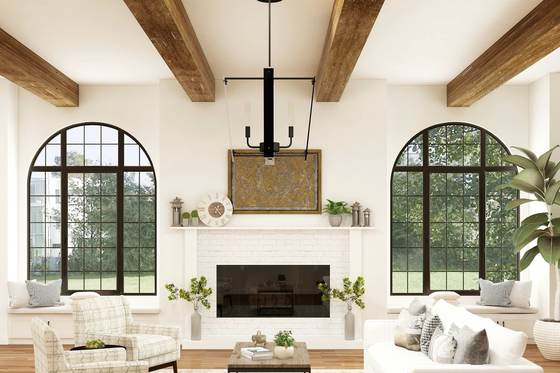
The palette
#F0EBE1
#A88158
#BDB5A6
#8E9B9E
#37332E
These are the actual values, not an impression of them — take them to a paint supplier and have them matched.
What it actually is
Modern farmhouse takes rural building materials — unfinished oak, painted timber panelling, iron fittings, honed stone — and uses them with contemporary restraint and contemporary layouts. Working farmhouses were practical, hard-wearing and plain, and that plainness is the part worth copying.
The one thing that decides whether it works
Quiet. This style has been reproduced more than anything else on this site, and almost all of the bad versions share a single fault: too much. Too many patterns, too many decorative objects, too many words on the walls.
The convincing version is nearly bare. Soft white walls and panelling, an aged oak floor, black iron, washed linen, and one or two genuinely old things. The materials are doing all of it, which is why they have to be real.
The materials
Get these right and the colours matter less than you think. Get them wrong and no paint colour rescues the room.
- Aged or reclaimed oak
- Wide boards, visible knots, matt oiled. Character is the point — a flawless uniform floor reads as the wrong style entirely.
- Painted timber panelling
- Shiplap, tongue and groove, or simple applied beading. The most effective single intervention in this style, and one of the cheapest.
- Matt black iron
- Handles, hinges, brackets, light fittings, curtain poles. Simple shapes rather than ornate ones; the modern half of the name lives here.
- Natural linen and cotton
- Loose, washed, slightly crumpled. Crisp and formal is the wrong register — this style wants fabric that looks used.
- Honed stone and fireclay
- Honed rather than polished stone surfaces, a fireclay or farmhouse sink, unglazed terracotta. Matt throughout.
Techniques that produce the look
- Panel one wall properly
- Full-height tongue and groove or shiplap, painted the same colour as the wall rather than a contrast. It adds texture and shadow without adding colour, and it is the style's signature move.
- Paint the woodwork the wall colour
- Skirting, architrave and panelling in the same shade as the wall, in a more durable finish. It calms the room and makes it feel larger than picking out the trim in white.
- Let the timber be the contrast
- If walls, trim and panelling are all one soft white, the oak floor and any beams become the only strong element. That is the composition — do not add a third.
- Mix old and new deliberately
- One genuinely old piece in a room of simple modern ones. The ratio matters: a room of entirely old things is a cottage, not a modern farmhouse.
- Keep the hardware consistent
- One finish, matt black, everywhere — handles, hinges, taps, curtain poles, light fittings. The consistency is what reads as considered.
What takes the look apart
- Decorative signs with words on them, which is the cliché the whole style is now judged by.
- Grey-washed timber. It dates the room immediately to a specific few years.
- Barn doors on anything that is not a doorway that genuinely suits one.
- Too much pattern. Gingham, florals and ticking stripe all at once turns it into a tea shop.
- Glossy finishes anywhere — the style is matt throughout.
Common questions
- How do I avoid the farmhouse cliché?
- Remove the words. No signs, no lettering, no slogans. Then keep the pattern to one, the metal to one finish, and let the materials carry it — oak, linen, honed stone and black iron are quietly convincing on their own.
- Is panelling expensive?
- It is one of the cheapest high-impact things you can do, especially tongue and groove or simple applied beading, which do not need a joiner. The cost is in the preparation and the painting rather than the material.
- What white should I use?
- A warm, soft off-white rather than a bright or cool one — something with a hint of yellow or a touch of grey warmth. Pure brilliant white is too hard against aged oak and makes the timber look orange.
- Does it work outside the countryside?
- Yes, if you lean on the modern half. The materials and the restraint work in a flat; the barn-door and signage version does not, and looks borrowed.