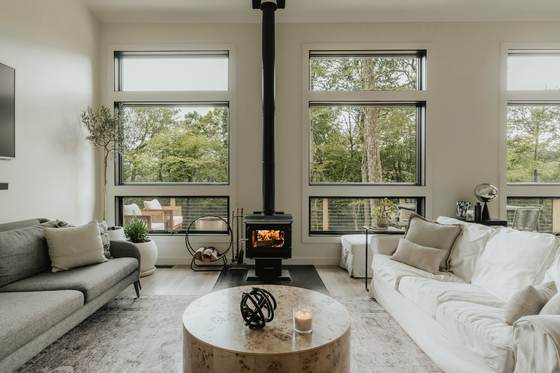
The palette
#F2EFE8
#D9C4A3
#C9C6BC
#8E9A8B
#2A2A28
These are the actual values, not an impression of them — take them to a paint supplier and have them matched.
What it actually is
Scandinavian interiors came out of a practical problem: long dark winters, small homes, and not much money. Every feature of the style traces back to one of those three. Pale surfaces because there is little daylight to work with. Simple multi-use furniture because the rooms are small. Honest, unfussy materials because they were what was affordable and they wear well.
That origin is useful, because it tells you what matters. If a decision makes a room feel lighter, calmer or more comfortable in winter, it belongs. If it is only there to look a certain way, it does not.
The one thing that decides whether it works
Warmth. Nearly every failed attempt at this style fails the same way: it goes cold. Cool white paint, grey flooring, a single bright ceiling light, and hard surfaces with no textile. The result is accurate to the photographs and unpleasant to sit in.
The correction is small and specific. Choose an off-white with a warm or yellow undertone rather than a blue one. Let the timber be genuinely warm. Put in several low, warm light sources. Add wool and sheepskin until the room looks slightly softer than you think it needs.
The materials
Get these right and the colours matter less than you think. Get them wrong and no paint colour rescues the room.
- Pale oak or ash
- Floors, table tops, chair frames. White-oiled or lye-treated rather than lacquered — the point is a matt, open grain you can see and feel, not a shine. Avoid anything with a strong orange or red undertone; that reads as 1990s pine, which is the failure mode of this style.
- Chalky, matt paint
- A flat or dead-matt finish on walls. The light in a Nordic winter is low and sideways, and a sheen turns that into glare. Matt absorbs it and keeps the wall soft.
- Undyed natural textiles
- Linen, wool, cotton, sheepskin. The warmth in a Scandinavian room comes almost entirely from texture rather than colour, so the textiles are doing most of the work.
- Black or blackened metal
- Window frames, lamp bases, handles, hinges. A small amount of near-black gives the eye somewhere to land and stops a pale room reading as unfinished.
- Paper and ceramic
- Paper lampshades, stoneware, unglazed or softly glazed. Matt, slightly imperfect surfaces.
Techniques that produce the look
- Keep one wall finish throughout
- The same chalk white on walls, ceiling and often the woodwork, running room to room. Continuity is what makes a small Nordic flat feel larger, and it is free.
- Layer three textures minimum
- Wool, linen and sheepskin in the same frame, all roughly the same colour. That is the actual trick: contrast of texture instead of contrast of colour.
- Light low and in several places
- Three or four small warm light sources at different heights rather than one ceiling fitting. Aim for 2700 K or warmer; cool white kills this style instantly.
- Let the floor be the warm element
- If the walls are near-white and the textiles are undyed, the floor is the only thing carrying warmth. Choose it first and let everything else sit against it.
- Leave surfaces empty
- Restraint is a technique, not an absence of one. Two objects on a sideboard, not nine. This is the hardest part and the one that most separates the real thing from the imitation.
What takes the look apart
- Cool white or blue-grey paint. It photographs well and lives badly, especially in a room with little daylight.
- Orange-toned varnished pine, which is the single fastest way to date the room.
- A single central ceiling light as the only lighting.
- High-gloss or satin wall paint — the glare undoes the softness the palette is for.
- Filling the restraint back in with accessories. If every surface has something on it, the style is gone.
Common questions
- Is Scandinavian style just white walls?
- No, and that is the common misreading. White walls are the background; the style is carried by pale matt timber, undyed natural textiles and a small amount of near-black. A white room with glossy modern furniture and a cool downlight is not Scandinavian, it is just white.
- Does it work in a dark room?
- It works better than most styles, because it is built for low light, but you have to go warm rather than bright. Use a warm off-white rather than a pure white, put in several low warm light sources instead of one bright ceiling fitting, and let the floor carry the warmth.
- What is the difference between Scandinavian and minimalist?
- Minimalism removes things. Scandinavian style keeps them and makes them plain and warm — wool, sheepskin, ceramics, books. A Scandinavian room is meant to be comfortable in winter, which is not minimalism's goal.
- What flooring suits it best?
- Pale oak or ash, white-oiled or lye-treated, in a wide board. Engineered board gives the same surface for less and is more stable over underfloor heating. The thing to avoid is a strong orange or red undertone.