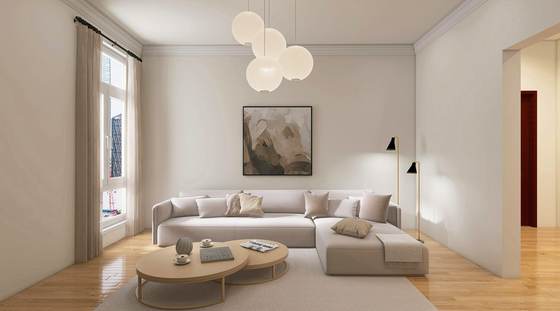
The palette
#E8E2D8
#CBB89C
#D2C9B9
#B19B7E
#B7A893
These are the actual values, not an impression of them — take them to a paint supplier and have them matched.
What it actually is
Minimalism gets blamed for a lot of cold, unpleasant rooms, and mostly the blame is misplaced: the problem was never the removal, it was that nothing was put back in its place.
Warm minimalism keeps the discipline — few objects, no visible clutter, no decorative noise — and shifts the whole palette to the warm side of neutral, then replaces visual interest with tactile interest. Limewash instead of flat emulsion. Bouclé instead of smooth fabric. Honed stone instead of polished.
The one thing that decides whether it works
Texture, and the storage that makes it possible.
Texture, because once you remove colour and pattern there is nothing else left to look at. A room painted one flat beige is not minimal, it is empty. The same room in limewash with heavy linen curtains and a bouclé chair is the same palette and a completely different place.
Storage, because this style only exists at all if everything has somewhere to go. That is a joinery decision made at the start of a renovation, not a styling decision made at the end.
The materials
Get these right and the colours matter less than you think. Get them wrong and no paint colour rescues the room.
- Limewash or mineral paint
- A chalky mineral finish with slight natural movement in the colour. It gives a flat wall the depth that a plastic emulsion cannot, and it is the single most valuable material in this style.
- Plaster and microcement
- Polished plaster, tadelakt or microcement on a wall or in a bathroom. Seamless, matt and slightly variable, which is exactly what a minimal room needs to avoid looking flat.
- Handleless joinery
- Push-to-open or routed finger pulls, fronts in the wall colour or a close timber tone. Visible hardware adds lines, and this style is about removing lines.
- Heavy washed linen
- Curtains to the floor, loose covers, bedding. Weight and drape are the main source of softness in a room with nothing else in it.
- One quiet stone
- Honed travertine, limestone or a soft-veined marble. Used in a single place — a worktop, a sill, a side table.
Techniques that produce the look
- Colour drenching
- Walls, ceiling, skirting, architrave and doors all in one colour, with the sheen changing rather than the colour. Edges dissolve, the room reads as larger and calmer, and it costs no more than painting them differently.
- Replace colour with texture
- When you take out pattern and contrast, something has to carry interest. Limewash, bouclé, heavy linen, honed stone and matt timber in a single tone give a room depth without a single contrasting colour.
- Storage before styling
- Minimalism is a storage problem disguised as a design style. Work out where everything lives first; the look is the consequence.
- Light the walls, not the room
- Wall washers, uplights and concealed strips graze the surface and reveal the texture. Downlights flatten it, which removes the only thing the room has.
- Vary the sheen, not the hue
- Matt on the walls, eggshell on the woodwork, the same colour in both. The difference is visible only as light moves across it, which is the effect you want.
What takes the look apart
- Cool grey, which is what turns warm minimalism into a dentist's waiting room.
- Bare walls with no texture. Empty and flat is not the same as minimal.
- Visible clutter, which this style has zero tolerance for — hence the storage point above.
- Downlights as the only lighting.
- A single accent colour used once, which reads as an apology rather than a decision.
Common questions
- What is colour drenching?
- Painting the walls, ceiling, skirting, architrave and sometimes the doors all in the same colour, usually varying the finish rather than the shade. The edges of the room stop announcing themselves, which makes a small room feel larger and a busy room feel calm.
- Is limewash worth the extra cost?
- In this style, yes, because it is doing the job that colour and pattern do elsewhere. Its slight natural variation is what stops a single-colour room looking flat. On a feature wall in a conventional scheme the difference matters far less.
- How is this different from plain minimalism?
- Temperature and texture. Classic minimalism runs cool, white and hard; this version runs warm, tonal and soft. The discipline is the same, the result is somewhere you want to sit down.
- Does it work with children?
- The palette does, surprisingly well, because warm neutrals hide a lot. The storage discipline is the hard part, and it has to be solved properly rather than hoped for.