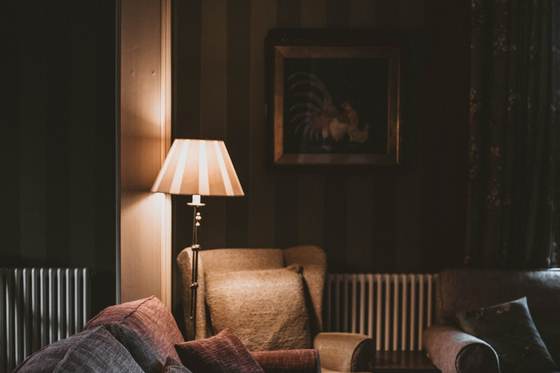
The palette
#2C3330
#6B5134
#B99B57
#7E4A38
#5A4228
These are the actual values, not an impression of them — take them to a paint supplier and have them matched.
What it actually is
Using deep colour across a whole room rather than as an accent. It draws on historic interiors, where rooms were often painted in saturated colours and lit by candle and firelight, and on the modern observation that a room with little daylight is more pleasant when you stop fighting that.
The current version keeps the depth and adds warm metal, visible timber grain and enough artificial light to actually use the room.
The one thing that decides whether it works
Commitment, and then lamps.
Commitment, because the halfway version — one dark wall, pale everything else — is the single most common way this fails. It reads as a decision someone lost their nerve on. Drenching the room, ceiling and woodwork included, is what makes it look intentional.
Lamps, because dark surfaces absorb the light you give them. A pale room forgives poor lighting; a dark room cannot. Plan five or six warm, low light sources from the start, and treat it as part of the cost of the scheme rather than something to sort out afterwards.
The materials
Get these right and the colours matter less than you think. Get them wrong and no paint colour rescues the room.
- Deep matt paint
- Dead flat or matt emulsion in a deep, complex colour — green-black, ink blue, aubergine, chocolate. Matt absorbs light and gives the colour depth; a sheen turns it into a reflective slab.
- Dark timber with figure
- Walnut, smoked oak, dark-stained ash. The grain has to be visible or the room becomes one undifferentiated mass.
- Antique and unlacquered brass
- Handles, light fittings, frames, taps. Warm metal is what keeps a dark room from reading as a void, and unlacquered brass improves as it ages.
- Velvet and heavy wool
- Textiles that catch light and hold shadow. Velvet in particular is the material that makes dark rooms look intentional rather than gloomy.
- Oxblood, rust and deep terracotta
- Warm accents against the cool depth of the walls. A single warm colour stops the scheme turning cold.
Techniques that produce the look
- Drench the whole room
- Walls, ceiling, skirting, architrave and doors in the same dark colour. A dark wall with a white ceiling draws a hard line and makes the ceiling look low. Drenched, the edges disappear and the room reads as deliberate and surprisingly larger.
- Add more light sources, not fewer
- Dark walls absorb light, so a dark room needs more lamps than a pale one — five or six low, warm sources rather than one bright ceiling fitting. This is the step most people skip, and it is why their dark room failed.
- Use matt on walls, sheen on woodwork
- Same colour, two finishes. The woodwork catches light where the wall does not, which is what gives the room its structure once the contrast is gone.
- Keep a warm metal running through
- Brass or bronze in at least three places. It is the only thing reflecting light back, and without it the scheme is flat.
- Let one thing be pale
- A cream lampshade, a stone surface, a pale artwork. One light point gives the eye somewhere to rest and makes the darkness read as a choice.
What takes the look apart
- A dark feature wall with three pale ones, which is the half-measure version and looks like an unfinished job.
- A white ceiling above dark walls, unless the room is genuinely tall.
- Too few light sources. This is the mistake that ruins most dark rooms.
- Cool-white bulbs, which turn deep colours muddy and grey.
- Chrome, which goes dead against a dark wall where brass glows.
Common questions
- Will dark walls make my small room feel smaller?
- Usually the opposite, if you commit. The reason a small room feels small is that you can see exactly where its edges are. Drench walls, ceiling and trim in one dark colour and the corners dissolve, so the boundaries become ambiguous. What does make it feel smaller is one dark wall with pale ones around it.
- What lighting does a dark room need?
- More sources, lower down, and warm. Five or six table and floor lamps at 2700 K or below rather than one bright ceiling light. Budget for the extra fittings at the start, because this is the part that decides whether the scheme works.
- Which dark colours work best?
- Complex ones with another colour underneath — a green-black, an ink blue with grey in it, a brown-aubergine. Flat pure black is harder to live with and tends to look like a hole. Test a large patch and look at it at night under your own lighting.
- Does it work in a room with little daylight?
- It is the one style on this site that does. A north-facing room will never be bright, so making it light is a losing fight; making it deliberately dark and warm turns the weakness into the point.