The palette
#C49A63
#37473A
#2F2D2A
#E2DACA
#7E5436
These are the actual values, not an impression of them — take them to a paint supplier and have them matched.
What it actually is
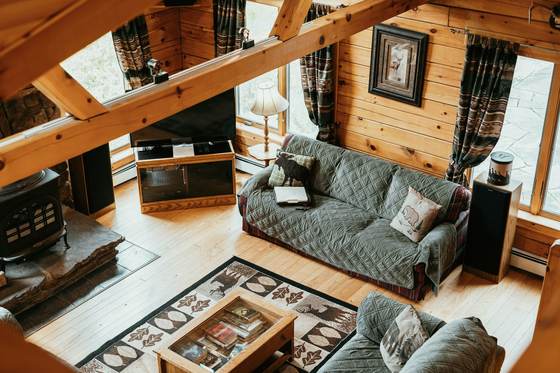
A cabin interior is organised around one problem: staying warm. The timber lining is insulation you can see, the stove is the centre of the plan, the textiles are there to be pulled over you, and the furniture faces the fire.
Everything that reads as charm in the style is a practical decision that happens to look good. That is also why the copies fail — they reproduce the look of the decisions without making any of them.
The one thing that decides whether it works
Breaking up the timber.
A room lined entirely in timber, floor to ceiling to floor again, becomes relentless. The eye has nothing to measure against, everything takes on the same colour cast, and the space reads smaller and more orange than it is.
One painted wall, one plastered gable, or a white ceiling changes it completely. The timber that remains reads as a deliberate material rather than as the only option available, and the room gains depth it cannot otherwise have.
The materials
Get these right and the colours matter less than you think. Get them wrong and no paint colour rescues the room.
- Solid timber, visible
- Walls, ceiling, beams. The grain and the joints are the decoration, so the timber has to be decent — knotty cheap board reads as a shed, not a cabin.
- Cast iron
- A stove, a kettle, hardware, a fire set. Black iron against timber is the contrast the whole scheme rests on.
- Wool, heavy
- Blankets, rugs, cushions, sheepskin. Wool is the softening element and there is no substitute for the weight of it.
- Leather, worn
- A chair or a sofa that has been sat in. New, shiny leather is wrong here in a way that is hard to fix.
- Stone
- A hearth, a chimney breast, a threshold. One stone element grounds the timber and stops it floating.
Techniques that produce the look
- Break up the timber
- Paint or plaster one wall, or the ceiling, or the gable end. Timber on every single surface is the difference between a cabin and a sauna, and the eye needs somewhere to rest.
- Centre the room on the heat
- The stove or the fire is the focal point and the furniture faces it. This is not styling, it is how these rooms were used, and it is why they feel right.
- Go dark on the metalwork
- Black iron throughout — hinges, handles, lighting, curtain poles, the stove. Consistent dark metal is what keeps a timber room from reading as orange.
- Layer wool until it looks excessive
- Then add one more. The warmth of the style is literal, and under-dressed timber rooms feel cold and echoey.
- Keep the lighting low and warm
- Table lamps, wall lights, candles. A bright ceiling light in a timber room turns everything the colour of a pine door.
What takes the look apart
- Orange varnished pine, which is the single thing that dates a cabin interior fastest.
- Timber on every surface with no relief.
- Novelty rustic signage, antlers bought rather than inherited, bear ornaments.
- Cool white lighting, which makes timber look yellow and dead.
- Leaving the floor hard and bare. Wool rugs are doing acoustic work as well as visual.
Common questions
- How do I stop a timber room looking orange?
- Three things: avoid orange-toned varnish and choose a white or grey-washed oil, break up the timber with one painted or plastered surface, and use warm lighting at 2700 K. Most orange cabins are a varnish problem lit by a cool bulb.
- Does this style only work in the countryside?
- The full version does, because it depends on a stove and a view. A flat can borrow the parts that travel — timber on one wall, wool, leather, black iron, warm low light — without pretending to be a mountain hut.
- What about a wood-burning stove?
- Installation is regulated almost everywhere, because the failure modes are carbon monoxide and chimney fire. Flue design, hearth construction and clearances to combustibles are all specified, and in most countries the work needs a qualified installer and a sign-off. Plan where it goes; do not fit it yourself.
- Is reclaimed timber worth it?
- For visible beams and feature walls, yes — the marks are what you are buying and new timber cannot fake them convincingly. Check it has been treated for insects and is dry, and expect it to be more work to fix than new stock.