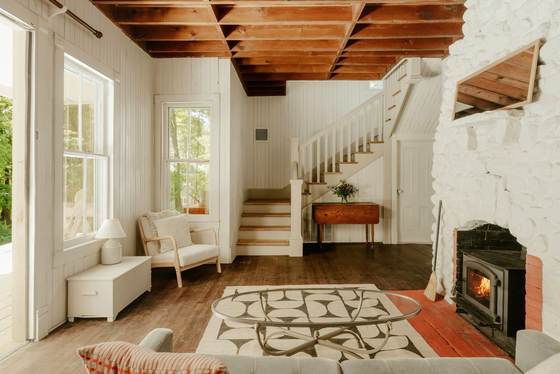
The palette
#F2EEE4
#96A189
#C8A472
#9B5A45
#8C8D87
These are the actual values, not an impression of them — take them to a paint supplier and have them matched.
What it actually is
Cottages were small houses built cheaply from whatever was local, by people with no interest in grandeur. Low ceilings to keep heat in, small windows, thick walls, a hearth at the centre, and every awkward corner used for something.
The style that comes out of that is soft, small-scale and completely unpretentious. It is also one of the few styles where the constraints are the charm.
The one thing that decides whether it works
Accepting the proportions.
Almost every unsuccessful cottage interior is a cottage being treated as a small version of a bigger house. Tall furniture under a low beam, a large pendant in a room with no headroom, oversized sofas in a room that cannot take them, big-scale wallpaper on a small wall.
Work the other way. Low furniture, horizontal lines, small patterns, lamps instead of pendants, pale ceilings so the low height stops announcing itself. The room becomes snug rather than cramped, and snug is what people actually want from a cottage.
The materials
Get these right and the colours matter less than you think. Get them wrong and no paint colour rescues the room.
- Painted tongue and groove
- On walls, ceilings, around baths, as cupboard doors. The cheapest high-impact material in the style, and the most characteristic.
- Exposed beams
- Low, honest, often not quite straight. Painting them white is a decision worth thinking twice about — it lightens the room and loses the character.
- Brick or stone hearth
- A fireplace or a stove recess in exposed masonry. Usually the only hard, dark element in the room, and it anchors everything.
- Small-scale print
- Ditsy florals, small checks, ticking. The scale matters: large patterns overwhelm small rooms, which is why cottage prints are traditionally tiny.
- Simple painted furniture
- Plain shapes in chalky colour. Nothing carved, nothing grand, nothing too large for the room.
Techniques that produce the look
- Work with the low ceiling
- Low furniture, horizontal lines, light-coloured ceiling, lamps rather than pendants. Fighting a low ceiling with tall furniture and big lights makes it feel lower, not higher.
- Paint the joinery, not just the walls
- Sage, soft blue or warm grey on cupboards, doors and panelling, with pale walls. One colour on the joinery is the whole scheme in most cottage rooms.
- Keep the pattern small
- Small-scale print in a small room, used on one or two things. It is the one place where tiny florals are genuinely the right answer.
- Build into the awkward spaces
- Window seats, understairs cupboards, alcove shelving, a bench in a nook. Cottages have odd corners and the good ones use every single one.
- Let the floor be forgiving
- Wide boards, flagstones, or something with enough texture to hide a dog and a muddy boot. Pristine floors are the wrong register here.
What takes the look apart
- Grand or oversized furniture, which makes small rooms look smaller.
- Large-scale pattern.
- Painting out every beam and every timber, which removes the only character the room has.
- Modern flush doors and plain trim, which read as wrong immediately in an old cottage.
- Overly twee styling. There is a short distance between cottage and gift shop.
Common questions
- How is cottage different from modern farmhouse?
- Scale and formality. Cottage is small, soft, slightly haphazard and uses tiny patterns; modern farmhouse is larger, cleaner and more restrained, with bigger rooms and almost no pattern. Cottage is cosy; farmhouse is airy.
- Should I paint the beams white?
- It makes the room lighter and loses most of its character, and it is very hard to undo. If the room is genuinely too dark to use, it can be the right call — but try lighting, floor and wall colour first, because all three are reversible and beams are not.
- How do I make low ceilings feel better?
- Keep furniture low, run lines horizontally, paint the ceiling the same pale colour as the walls so the junction disappears, and light with lamps rather than pendants. Accepting the height and working with it reads as intentional; fighting it never does.
- Are old cottages difficult to renovate?
- Often, yes. Solid walls, lime mortar and timber frames behave differently from modern construction, and the usual modern answers for damp and insulation can cause real damage. In an old building this is specialist territory, and it is worth the right advice before anything is sealed.