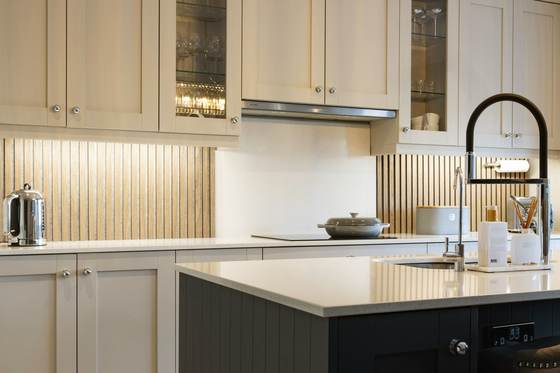
The palette
#F4F1E9
#E3DFD5
#43505A
#CDAA78
#2B2927
These are the actual values, not an impression of them — take them to a paint supplier and have them matched.
What it actually is
The Shakers were a religious community in eighteenth and nineteenth century America whose beliefs produced a design philosophy almost by accident. Work was worship, so things were made as well as possible. Ornament was vanity, so there was none. Order mattered, so everything had a designated place.
What came out was furniture and interiors of extraordinary plainness and quality: flat panels, visible joinery, peg rails, built-in storage, and nothing that existed only to be looked at.
The one thing that decides whether it works
Taking the principle, not just the door.
Almost every "shaker kitchen" on the market borrows one detail — a flat-panel door, usually with a moulding the Shakers would not have used — and ignores everything else.
The real version is about the whole room. Storage built into the architecture rather than bought. A peg rail that keeps the floor clear. Painted joinery in a proper colour. Hardware that is plain because plain works. And the governing rule underneath all of it: if a thing has no use, it does not belong there.
That rule is also why the style has lasted two hundred years without looking dated. Nothing in it was ever fashionable in the first place.
The materials
Get these right and the colours matter less than you think. Get them wrong and no paint colour rescues the room.
- Flat-panel timber joinery
- A plain recessed panel in a plain frame, with no moulding on the edge. The profile is the whole thing, and a bevelled or ogee edge is not Shaker, whatever a kitchen showroom calls it.
- Solid timber worktops
- Maple, oak or beech, oiled. The Shakers worked in solid wood because it was honest and repairable, and both qualities still hold.
- Peg rail
- A simple rail of turned pegs at picture-rail height, running round the room. Chairs, tools, clothes and lamps hung from it. The single most Shaker thing you can build, and almost nobody does.
- Black iron and simple brass
- Plain knobs, simple latches, nothing ornate. Hardware that does its job and stops.
- Milk paint and chalky finishes
- Flat, slightly absorbent, in muted historical colours. Shaker interiors were painted, often in strong blues and greens, not only in cream.
Techniques that produce the look
- Build the peg rail
- It is cheap, it is the defining feature of a Shaker room, and it genuinely changes how the space works. Floor space stays clear because things go on the wall.
- Keep the door profile plain
- Flat recessed panel, square edges, no moulding. The moment there is a profile on the inside edge it stops being Shaker and becomes generic traditional.
- Use real colour on the joinery
- Shaker interiors used saturated blues, greens and ochres. The all-cream version is a modern invention and it misses what the original rooms actually looked like.
- Everything has its place
- Built-in drawers, cupboards to the ceiling, dedicated storage for each thing. The Shakers built storage into the architecture rather than buying furniture.
- Nothing purely decorative
- The governing rule of the original style: if an object has no use, it does not belong. That single idea produces the restraint everything else follows from.
What takes the look apart
- Cabinet doors with a moulded inner edge sold as shaker. The profile is the definition.
- The all-cream kitchen. Historically wrong and visually flat.
- Ornate hardware, which contradicts the governing principle.
- Decorative objects with no function, for the same reason.
- Treating it as only a kitchen style. It is a whole approach to a room.
Common questions
- What actually makes a door shaker?
- A flat recessed centre panel in a plain frame with square, unmoulded edges. That is the entire definition. Most kitchens sold as shaker have a small moulding on the inner edge of the frame, which makes them generic traditional doors.
- Is Shaker only for kitchens?
- No, and treating it as a kitchen style is why it is usually done so thinly. It is an approach to a whole room: built-in storage, a peg rail, painted joinery, plain furniture and nothing purely decorative. Bathrooms, utility rooms and bedrooms all take it well.
- What colours are historically right?
- Stronger than most people expect — deep blues, blue-greens, ochres and barn reds, in flat milk paint, alongside plenty of plain timber. The restrained cream-and-grey version is a modern commercial reading.
- Why is Shaker so popular?
- Because the plain profile does not date, it suits both old and new houses, and it is straightforward for a joiner to make well. It is one of very few styles that looks correct in a Georgian cottage and in a new extension.