The palette
#D9D2C6
#A89580
#4B463E
#BFB7AA
#6A7158
These are the actual values, not an impression of them — take them to a paint supplier and have them matched.
What it actually is
Wabi-sabi is a Japanese aesthetic idea long predating its use as an interiors label: beauty in what is imperfect, impermanent and unfinished. A cracked bowl mended with visible lacquer is more interesting than an unbroken one, because it carries its history.
Applied to a room, it means raw rather than sealed surfaces, asymmetry rather than matching, very few objects, and a deliberate preference for things that show their age.
The one thing that decides whether it works
It cannot be bought in one go, and the light has to be right.
Both halves matter. A roomful of new objects designed to look old is the precise opposite of the idea, and it reads as such immediately. The few things in the room need to have actually lived.
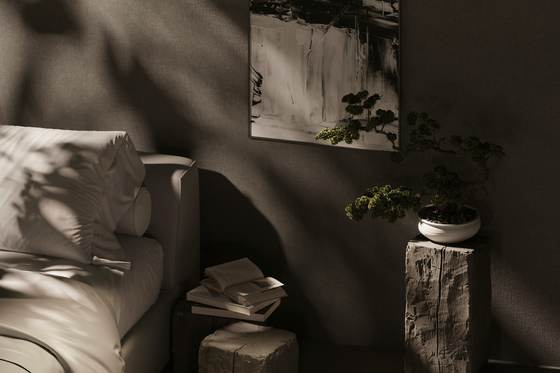
And the light does more work here than in any other style. The whole effect rests on a textured wall with low light raking across it, so that the surface has depth and the shadows change through the day. Light it flatly from the ceiling and the same room is simply beige and empty.
The materials
Get these right and the colours matter less than you think. Get them wrong and no paint colour rescues the room.
- Raw and unsealed plaster
- Lime or clay plaster with visible trowel movement, left matt and slightly chalky. The surface is the main event, so it has to be applied by someone who understands that flat is not the goal.
- Unglazed and repaired ceramic
- Hand-thrown, uneven, sometimes mended. A visible repair is a feature in this style, not damage — that idea is the heart of it.
- Weathered timber
- Grey, split, worn smooth by use. Reclaimed beams, old boards, a bench with a hollow worn into it.
- Raw stone
- Unpolished, irregular, used as a plinth or a step or a bowl. One heavy element grounds a room of soft surfaces.
- Undyed, uneven textiles
- Rough linen, hemp, raw cotton. Slubs and irregularities in the weave are the point.
Techniques that produce the look
- Choose the light before the objects
- Low raking light across a textured wall is what this style actually is. A side window, a lamp close to the plaster, a shadow that moves through the day. Flat overhead light erases it entirely.
- Keep it almost empty
- Very few objects, well spaced, each with presence. Density is the enemy — this is the most restrained style on this site.
- Let things be asymmetric
- Nothing centred, nothing matched. Where other styles use symmetry for calm, wabi-sabi uses balance without matching.
- Repair visibly
- A mended bowl, a patched textile, a filled crack left legible rather than hidden. The history of the object is part of what it is.
- Narrow the palette to earth
- Clay, stone, ash, undyed linen, one green. No saturated colour anywhere, and nothing that reads as new.
What takes the look apart
- Buying a wabi-sabi look as a set of new objects, which is a contradiction and looks like one.
- Artificially distressed furniture. Fake wear is the opposite of the idea.
- Flat overhead lighting, which removes the texture the whole style depends on.
- Cool greys. The palette is warm earth, not concrete.
- Filling the room. At a certain density it becomes rustic, which is a different style.
Common questions
- What does wabi-sabi actually mean?
- It is a Japanese aesthetic idea, roughly: finding beauty in things that are imperfect, impermanent and incomplete. In an interior it means valuing wear, age, asymmetry and natural irregularity rather than treating them as problems to correct.
- Is this just minimalism with old things?
- There is overlap in the restraint, but the attitude is opposite. Minimalism wants perfect surfaces and hides what fails; wabi-sabi wants surfaces that record time and leaves the repair visible. One is about control, the other about acceptance.
- Can I do this in a new-build?
- Yes, and it is a good use for a characterless room — the plaster, the light and a few genuinely old objects do most of it. What you cannot do is buy the age, so the few old things you use have to actually be old.
- How do I get the plaster finish?
- A lime or clay plaster applied by someone who will leave movement in it, or a limewash over a prepared wall as the cheaper version. Show references and say explicitly that you do not want it flat — most plasterers are trained to deliver the opposite.