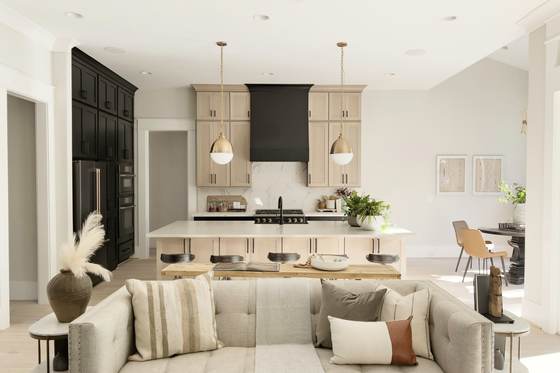
The palette
#EDE7DC
#C2A179
#C4A58C
#D9CDB9
#3A3732
These are the actual values, not an impression of them — take them to a paint supplier and have them matched.
What it actually is
Organic modern is the current answer to a decade of hard-edged grey minimalism. It keeps the discipline of modern design — simple forms, limited palette, no ornament — and softens every edge, warms every colour, and replaces engineered surfaces with natural ones.
The result reads as calm rather than austere, which is what people actually wanted from minimalism in the first place.
The one thing that decides whether it works
Consistency in the curves.
A room with an arched doorway, a round mirror of a different radius, a kidney table, a curved sofa and a wavy shelf is not organic modern. It is five unrelated curves arguing.
Pick a radius and repeat it. The arch over the opening, the rounded edge of the joinery, the corner of the island, the mirror. That repetition is what makes the softness read as a decision, and it is the difference between a sculptural room and a cartoon one.
The materials
Get these right and the colours matter less than you think. Get them wrong and no paint colour rescues the room.
- Travertine and limestone
- Honed, warm, with visible pitting and movement. The signature stone of the style, used on a table, a plinth or a worktop.
- Pale to mid oak, rounded
- Softened edges, chunky sections, oiled matt. Joinery with a radius rather than a sharp arris is what reads as organic.
- Bouclé and heavy weave
- Textured, pale, soft. Bouclé on a curved chair is practically the uniform of this style.
- Plaster and microcement
- Seamless matt surfaces with slight natural variation, on walls and sometimes on built-in furniture.
- Sculptural ceramic
- Large, simple, matt forms. Few objects, each with presence, in the same palette as everything else.
Techniques that produce the look
- Curve the architecture, not just the furniture
- An arched opening, a rounded wall return, a curved island end, a softened plinth. Curves built into the room read as architecture; a roomful of curved furniture in a square box reads as a showroom.
- Keep one curve radius
- Pick a radius and repeat it — the arch, the joinery edge, the mirror, the table. Several different curve sizes in one room look accidental.
- Hold the palette to five warm neutrals
- Bone, clay, oak, travertine, one dark. The restraint is what lets the shapes read, and shape is the whole point here.
- Vary texture, not colour
- Bouclé against honed stone against oiled oak against matt plaster. With a palette this narrow, texture is the only source of contrast.
- Leave generous space around things
- Curved furniture needs air to read as sculptural. Pushed tight against walls or each other it just looks bulky.
What takes the look apart
- Curves at five different radii, which is the commonest way this goes wrong.
- Cool greys and stark whites, which turn organic modern into ordinary contemporary.
- Overfilling. These shapes need space around them.
- High-gloss anything. The whole palette is matt.
- Curved furniture in a room with no curved architecture — it never quite resolves.
Common questions
- What is the difference between organic modern and warm minimalism?
- Shape. Warm minimalism is about removing things and using texture; organic modern keeps a similar palette but is driven by curved, sculptural form. One is defined by what is absent, the other by what the shapes do.
- Is travertine practical?
- It is porous and it etches with acid, so on a kitchen worktop it needs sealing and tolerance for marks. On a coffee table, a plinth or a bathroom surface it is far easier to live with, and that is usually where it belongs.
- How do I get curved architecture without a big build?
- A new stud partition can be formed with an arch cheaply, and curved joinery ends are a specification rather than a structural change. Cutting an arch into an existing wall is a different matter and may be structural, which needs checking before anything is cut.
- Does it date quickly?
- The palette and the materials do not. The specific curved-furniture silhouettes popular right now probably will, so put the money into the architecture, the stone and the timber, and treat the sculptural seating as the replaceable layer.