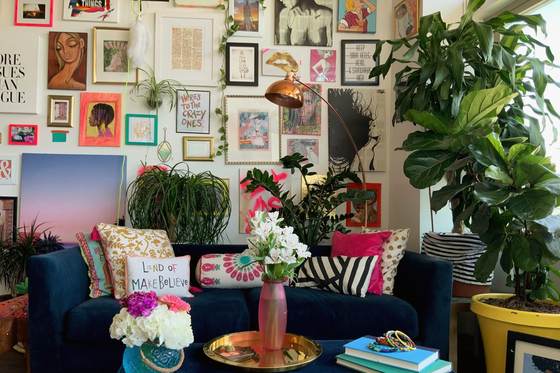
The palette
#253A66
#F1ECE2
#B9C24A
#C2466E
#B4913F
These are the actual values, not an impression of them — take them to a paint supplier and have them matched.
What it actually is
Maximalism is a reaction to a decade of grey minimalism, and it is older than that reaction — most historical interiors were maximalist, because things were expensive and you kept them and displayed them.
What it is not is an absence of discipline. The convincing maximalist rooms are tightly controlled: a defined palette, graded pattern scales, deliberate repetition, and one area left deliberately quiet.
The one thing that decides whether it works
The palette, held.
Write down four or five colours before you buy anything, and then refuse anything outside them, however good it is on its own. That single constraint is what separates the maximalist rooms people photograph from the rooms people apologise for.
The second rule follows from the first: use each colour at least three times, in three different places and at three different sizes. One appearance reads as an accident; three reads as a decision.
The materials
Get these right and the colours matter less than you think. Get them wrong and no paint colour rescues the room.
- Saturated upholstery
- Velvet, bold cotton, strong solid colour. Large pieces in full-strength colour are the anchors that everything smaller hangs off.
- Pattern at three scales
- A large-scale pattern, a medium one and a small one in the same room. Three scales read as layered; two read as a clash.
- Framed work, in quantity
- A gallery wall is the style's signature. Mixed frames, mixed subjects, hung tight with even gaps.
- Plants as mass
- Large, several, at different heights. Green is the colour that lets every other colour in the room get along.
- Brass and warm metal
- Lighting, frames, hardware. A consistent warm metal running through chaos is a quiet unifying thread.
Techniques that produce the look
- Pick a palette and actually hold it
- Four or five colours, repeated everywhere. This is the rule that separates maximalism from clutter, and it is the one people skip because the style looks like it has no palette. It always does.
- Three pattern scales
- Large, medium, small, sharing at least one colour. Two large patterns next to each other fight; three graded scales read as deliberate.
- Hang the gallery wall tight
- Even gaps, 50 to 70 mm, treated as one block with straight outer edges. Loose random spacing is what makes a gallery wall look accidental.
- Leave one surface empty
- One wall, one table, one corner with nothing on it. The eye needs a rest, and the empty space is what proves the rest was a choice.
- Repeat every colour three times
- A colour used once looks like a mistake. The same colour in a cushion, a book spine and a vase reads as a scheme.
What takes the look apart
- No palette. Everything bright is not maximalism, it is a jumble sale.
- Loose, uneven gallery-wall spacing.
- Filling every surface, which removes the contrast that makes the full areas work.
- Small patterns only, which reads as busy rather than bold.
- Adding things without removing any. Maximalism is edited, just at a higher density.
Common questions
- Is maximalism just clutter?
- No, and the difference is testable: a maximalist room has a palette you can write down in five colours, and a clutter room does not. Density is not the variable — intent is.
- Where do I start?
- With the palette and one large anchor piece, usually a sofa or a rug in a full-strength colour. Then add in layers, repeating each colour at least three times, and stop when one surface is still empty.
- Does it work in a small room?
- Very well, and small rooms are often the best place for it — a downstairs cloakroom, a study, a hallway. A small space cannot be made to feel large, so making it feel rich instead is the stronger move.
- How do I hang a gallery wall?
- Lay it out on the floor first, keep the gaps even at 50 to 70 mm, and treat the whole group as one rectangle with straight outer edges. Paper templates taped to the wall before any hole is drilled will save you a wall full of filler.