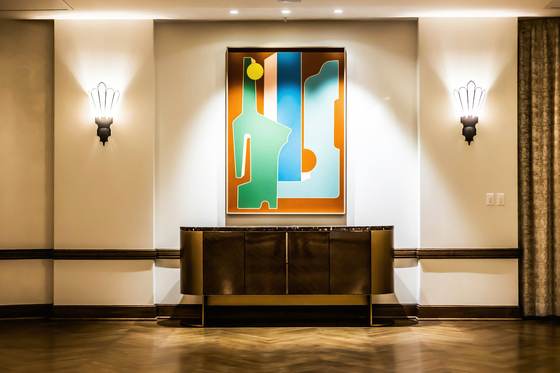
The palette
#1F3A34
#B08D4B
#6E2B2B
#EDE5D5
#5C4026
These are the actual values, not an impression of them — take them to a paint supplier and have them matched.
What it actually is
Art deco came out of the 1920s and 1930s, and it was about optimism and machinery: ocean liners, skyscrapers, speed. The vocabulary is geometric rather than floral, symmetrical rather than loose, and it uses materials that were expensive and new at the time — lacquer, chrome, exotic veneer, mirror.
The domestic version that works now is the calmer later end: deep saturated walls, brass, velvet, strong vertical lines, and far fewer sunbursts than people expect.
The one thing that decides whether it works
Where you put the geometry.
Deco is a geometric style, and the question is whether the geometry is in the building or on the shopping list. A fluted timber panel, a stepped cornice, an inlaid floor border, a reeded glass screen — these read as architecture, and they age well.
A sunburst mirror, a fan-shaped cushion and a geometric print, bought together, read as a costume. Same motifs, completely different result, and the difference is whether the room was built or accessorised.
The materials
Get these right and the colours matter less than you think. Get them wrong and no paint colour rescues the room.
- Lacquer and high-gloss timber
- Deep, mirror-finish surfaces on cabinetry and tables. This is the one style on this site where gloss belongs, and it needs a flawless substrate underneath.
- Brass, everywhere but consistently
- Inlay lines, handles, light fittings, frames, trim on glass. Antique or unlacquered rather than bright — deco brass should look like it has been in the room a while.
- Velvet and silk
- Deep jewel colours with a visible pile that changes with the light. Velvet is the textile that makes deco read as luxurious rather than merely dark.
- Figured stone and marble
- Strong veining, used as a feature: a fireplace surround, a table top, a bar. Deco likes stone that announces itself.
- Patterned glass and mirror
- Fluted, reeded or bevelled. Mirror used architecturally rather than as an object — a mirrored panel, a mirrored alcove back.
Techniques that produce the look
- Build the geometry in
- Fan shapes, sunbursts, stepped forms, chevrons, strong vertical lines. Put the geometry in the architecture — a fluted panel, a stepped cornice, an inlaid floor — rather than buying it as a cushion.
- Commit to symmetry
- Matched pairs either side of a focal point, centred compositions, repeated verticals. Deco is formal, and asymmetry reads as a mistake rather than a flourish.
- Contrast dark with cream
- Deep walls need a light relief or the room becomes a cave. A cream ceiling, a pale rug, a light lampshade.
- Repeat one geometric motif
- Pick a single shape — a fan, a stepped line, a chevron — and repeat it at three different scales. That repetition is what makes a deco room read as designed rather than decorated.
- Light it theatrically
- Wall lights and uplights rather than a flat ceiling wash. The style was designed for warm, directional, slightly dramatic light.
What takes the look apart
- Buying novelty deco-themed objects, which turns the room into a film set.
- Doing it by halves. One deco cushion in a neutral room is not a style, it is a cushion.
- Chrome and cool metals, which belong to the later modernist end rather than to deco proper.
- Gloss over a wall that is not flat — high sheen reveals absolutely everything.
- Maximal pattern on top of maximal colour. Deco is bold but it is also controlled.
Common questions
- Is art deco too much for a small room?
- Not at all — small rooms are where it often works best, because the style is built on dark colour and strong verticals, both of which suit a space you cannot make feel large anyway. A small deco cloakroom or bar is a classic for good reason.
- How do I avoid making it look like a theme?
- Put the geometry in the architecture rather than in accessories, and stop at one repeated motif. A fluted panel reads as deco; a cocktail shaker ornament and a flamingo print read as a party.
- Which era does the palette come from?
- Roughly 1920 to 1940. The deep greens, oxbloods and inky blues with brass come from the later, more restrained end of it; the brighter pastels and chrome belong to the American streamline version, which is a different look.
- Does gloss paint need special preparation?
- Yes, and it is most of the cost. The higher the sheen, the more every ripple, filler mark and sanding scratch shows. A deco gloss finish is almost entirely a preparation job with a thin coat of paint on top.