The palette
#E8DFD0
#B9674A
#C9A870
#8E4A32
#2F5F63
These are the actual values, not an impression of them — take them to a paint supplier and have them matched.
What it actually is
Bohemian borrows from everywhere — North African textiles, South Asian block-print, mid-century rattan, Victorian plant-collecting — and the borrowing is the point. It came out of a way of living rather than a design movement: pick things up, keep them, put them together.
That origin tells you what matters. A boho room should look like it accumulated over years, because the good ones did.
The one thing that decides whether it works
Editing, and a quiet background.
The failure mode is not that there is too much. It is that there is too much of nothing in particular. Every object in a convincing boho room is something the owner actually chose; the room is dense but not random.
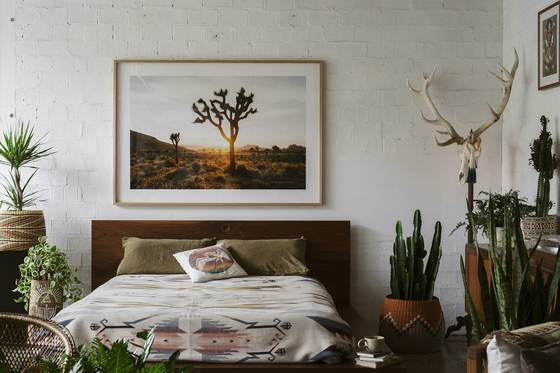
And the walls stay plain. Warm plaster, off-white, maybe one terracotta wall. The layers need something to sit against, and if the background is as busy as the foreground the eye has nowhere to rest.
The materials
Get these right and the colours matter less than you think. Get them wrong and no paint colour rescues the room.
- Natural fibre, in quantity
- Rattan, jute, seagrass, cane, macramé. This is the structural material of the style — it is what gives a boho room its texture where another style would use colour.
- Layered textiles
- Kilim, flatweave, vintage rug over a plain one, throws, floor cushions. Layering rather than matching is the whole technique.
- Plants, lots of them
- Not one statement plant — a collection at different heights, in mismatched pots. Plants are furniture in this style, not decoration.
- Low-fired and handmade ceramic
- Visible throwing marks, uneven glaze, terracotta left unglazed. The hand has to be visible.
- Warm timber and cane furniture
- Mid-tone, often vintage, often slightly battered. Perfect new furniture fights the style.
Techniques that produce the look
- Collect, do not buy a set
- The look depends on things having arrived at different times from different places. A room bought in one order on one afternoon reads as a catalogue page, however correct the palette.
- Layer rugs
- A large plain jute as the base, a smaller patterned rug on top at an angle. One move, enormous effect, and it is the single most recognisable boho technique.
- Work in threes and odd numbers
- Plants, cushions, ceramics, framed pieces — grouped in threes and fives at different heights. Even pairs read as formal, which is the opposite register.
- Keep the walls quiet
- A warm plaster or off-white background lets the layers read. Boho with busy walls as well as busy everything is just noise.
- Let one thing be old and odd
- A piece with a history and no obvious place. This is what separates a collected room from a styled one.
What takes the look apart
- Buying a complete boho set from one shop in one go. It reads immediately.
- Cool greys, which kill the warmth the whole palette depends on.
- Matching everything — matching is the opposite of the technique.
- Plastic plants. In a style where plants are structural, fake ones are visible from the doorway.
- Clutter without editing. Layered and messy are different things, and the line is whether each thing earns its place.
Common questions
- What is the difference between bohemian and maximalist?
- Bohemian is warm, natural and relaxed — earth tones, natural fibre, plants, texture. Maximalist is about colour, pattern and quantity, and it can be slick and urban. Boho is a backpacking trip; maximalism is a gallery.
- How do I keep it from looking messy?
- Edit, and keep the background plain. Layering works when the walls and the large surfaces are quiet, and when each object is something you actually chose. Messy is what happens when things accumulate rather than get chosen.
- Does boho work in a small flat?
- Well, because the style is built on soft furnishings and plants rather than furniture. Keep the furniture low and few, go vertical with plants and shelving, and let the textiles do the work.
- Which plants if I am not good with plants?
- Height matters more than variety, so a few large forgiving plants beat a shelf of fussy ones. Any plant catalogue will tell you which tolerate low light and irregular watering — pick from that list and group them in odd numbers.