The palette
#F0EAE0
#C2714C
#6E7A52
#A8884F
#3C6A80
These are the actual values, not an impression of them — take them to a paint supplier and have them matched.
What it actually is
Every feature of Mediterranean style began as a response to heat. Thick walls of lime plaster hold cool. Small deep windows keep sun out. Pale surfaces reflect it. Hard floors stay cold underfoot. Shutters rather than curtains let air pass while blocking light.
That is worth knowing because it tells you which parts travel and which do not. The materials and the palette work anywhere. The logic of keeping heat out does not, in a country where the problem is keeping it in.
The one thing that decides whether it works
The plaster, and whether you allow it to be imperfect.
This is a style built on a hand-applied finish with visible movement in it — brush marks, soft variation in tone, edges that are not quite straight. That irregularity is what makes a white room look like a Mediterranean house rather than an empty new-build.
It is also the thing most likely to be sanded out by a decorator doing their usual good job. Specify it explicitly, show a reference, and accept that it will feel wrong to someone trained to make walls flat.
The materials
Get these right and the colours matter less than you think. Get them wrong and no paint colour rescues the room.
- Limewash and lime plaster
- Soft, chalky, slightly uneven, with visible brush movement. The irregularity is the point — a perfectly flat machine finish in this palette looks like a rendered new-build.
- Terracotta and unglazed clay
- Floor tile, pots, roof tile used as a detail. It warms with age and wear rather than looking tired, which is why it suits a house with children.
- Dark stained or reclaimed timber
- Beams, doors, shutters, simple furniture. Chunky, unfussy, often almost black against the white.
- Hand-painted tile
- Blue and white, green and white, used in a small defined area — a splashback, a stair riser, a bathroom niche. A little goes a long way.
- Rattan, rush and olive wood
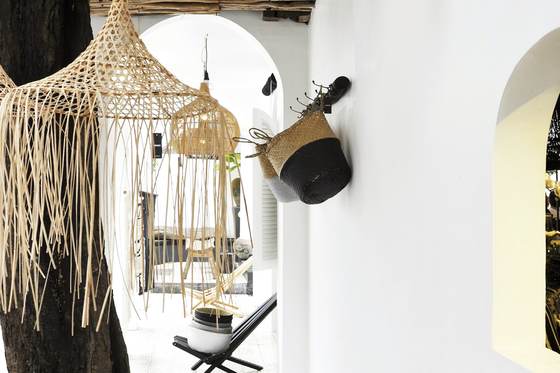
- Pendant shades, chair seats, bowls. Natural fibre softens an otherwise hard palette of plaster and tile.
Techniques that produce the look
- Round the corners
- Arched doorways, curved wall returns, a rounded niche, a plastered bench. Curves are the single most recognisable Mediterranean move and they cost almost nothing in a new partition wall.
- Let the plaster be uneven
- Brush marks, soft variation, slightly wavy edges. If the finish is machine-flat the style does not read. This is one of the few places where you specify imperfection and mean it.
- Dark against white
- Nearly black timber or iron against the limewash. That contrast is what gives the style its graphic strength; without it the room is just pale.
- Build in, do not furnish
- A plastered bench, a built-in seat, a niche, a shelf formed from the wall. Mediterranean rooms traditionally had very little loose furniture.
- Keep the window dressing minimal
- Shutters, or nothing, or a single light linen curtain. Heavy drapery is from a different tradition and immediately breaks it.
What takes the look apart
- A flat modern plaster finish, which removes the one quality the walls are for.
- Covering the floor. Terracotta wants to be seen, with at most a small flat rug.
- Hand-painted tile over large areas, which turns from charming to overwhelming very quickly.
- Cool white paint. The whole palette sits warm.
- Heavy curtains and carpet, both of which belong to a northern tradition and fight everything else.
Common questions
- Does Mediterranean style work in a cold northern climate?
- The materials do, the logic needs adjusting. Terracotta over underfloor heating is lovely; terracotta over a cold slab is brutal in February. Keep the plaster, the curves, the timber and the palette, and be careful with the hard floor unless it is heated.
- Is limewash practical?
- In living spaces yes, and it is breathable, which suits older solid-wall buildings. It marks more easily than modern emulsion and it cannot be wiped, so in a hallway with children it is a maintenance decision rather than only a style one.
- How do I get the curved arches?
- In a new stud partition it is straightforward and inexpensive — the curve is formed in the framing and boarded over. Cutting an arch into an existing wall is a different question entirely and may be structural, which needs an engineer before anything is touched.
- What is the difference between Mediterranean and Spanish or Moroccan style?
- They overlap heavily. Spanish leans on dark timber, wrought iron and terracotta; Moroccan on pattern, zellige tile and carved detail; Greek island on white, blue and minimal furniture. The palette and the plaster are shared; the ornament is where they part.